January 27, 2012

How Are Seller Ratings Affecting Your AdWords ROI?


What happens to your CTR and ROI when you allow your website’s seller ratings to be displayed as an ad extension on your Google AdWords ads?  While you might think it’s great that your seller ratings are now being displayed, you need to view the experience as your potential site visitors do.

Here is what happened when I searched for “silk turtleneck” on Google.com:
Two of the top three paid search ads have seller ratings of roughly 4.5/5.0 stars.  But, that’s not all.  Here are the remainder of the paid search ads that appeared in the right column (this is just the Page 1 search results):
Half of these ads have seller ratings of roughly 4.5/5.0 stars.  Two ads have seller ratings of 5.0/5.0 stars.  Can we say redundant?

At this point, the ads that stand out are the two ads that don’t display seller ratings.  Is that a good thing?  Not necessarily.  A larger brand with higher levels of recognition, such as Ralph Lauren, can easily get away without having their site’s seller ratings displayed with their AdWords ads without having web surfers question if the lack of the seller ratings means that the site is questionable to shop on.  A smaller, lesser-known brand may run into the issue of web surfers questioning the integrity of shopping on that sight and choosing to click on one of the paid search ads that displays a high seller rating (though they all have high seller ratings).

Before you rush to check if your AdWords ads are displaying your seller ratings, here are a few points to take into consideration:
  1. Google is automatically displaying seller ratings on AdWords accounts for those domains that have at least 30 unique user reviews and a seller rating of at least 4.0 stars on Google Product Search. (This is the point that doesn’t make sense to me.  Most people using Google to search for a product or service are not aware that only the 4.0 or higher ratings are being displayed.  Google really needs to eliminate the minimum 4.0 star rating and display all the ratings.  If a site has a seller rating of 2.0/5.0 stars, display that so anyone who clicks on that paid ad has an expectation that they might have a really bad customer experience if they decide to purchase from that site.)
  2. Google Product Search seller ratings are really an aggregate of ratings from third-party sites, such as BizRate and Epinions, and Google Checkout reviews.  SMBs that don’t want to pay for BizRate, etc., will need to add Google Checkout to their sites in order to build up to the minimum of 30 reviews.
  3. The seller ratings currently are only displayed for searches on the following Google domains: .com, .co.uk, .de, .fr, and .nl.
Going back to the Page 1 search results that displayed on Google.com for “silk turtleneck”, one organic search result demonstrates how to trump the paid search seller ratings:

The listing for Orvis.com displayed the product rating with the number of reviews for that specific product.  When I moused-over the right arrows, I could see in the page preview that the page is for a silk turtleneck (just what I searched for) and that it’s available in four colors.  While 27 product reviews doesn’t sound like very many reviews, do you think your site’s personas would be more likely to click on any link, paid or organic, based on your site’s overall seller ratings or on the product-specific ratings?

Here are the next steps to consider:
  1. If your AdWords ads are displaying your seller ratings, check your AdWords and site stats.  Have the ratings had a positive or negative impact on your conversions, ROI, and CTR?  If you’re seeing a decrease in conversions and ROI, fill out Google’s form to notify them you want the seller ratings removed from your AdWords ad extensions.  If your CTR has decreased but your conversions and ROI have not decreased, you probably want to look at the keywords you’re bidding on and your title and ad copy.  (Take a look at the first image in this post, neither the RalphLauren.com nor VictoriasSecret.com ads contains the keyword “silk” and the RalphLauren.com ad doesn’t even contain the keyword “turtleneck” yet both of those ads were triggered by my search for “silk turtleneck”.)
  2. If you’re not using the product extension option for your ad extensions, do so.  You just need to link your Google Merchant Center account (free to set up and upload your product info to) to your AdWords account. 
  3. Include product reviews on your product pages.  Look at the advantage Orvis has in the organic results for the search I performed.  Orvis’ product page isn’t first in the organic results, but their product page stands out because it’s the only organic result on this page with the product rating.
  4. Don’t forget SEO on your product and category pages.  No, you’re not going to get into the Page 1 search results overnight, but it’s worth the investment.  (Please use a better description tag than what Bluefly.com did.  Blatantly trying to get the keyword twice in your description tag by stating that the turtleneck is a turtleneck makes you look lazy and like you didn’t take the time to identify your primary personas.)

On that note, what do you think of Google displaying the seller ratings on AdWords ads?  Have you, or your clients, seen positive or negative changes to your AdWords account since the seller ratings went live?

January 23, 2012

The Diamond Thief’s Guide to Marketing


As I was reading the book Flawless: Inside the Largest Diamond Heist in History by Scott Andrew Selby and Greg Campbell, I noticed that the diamond thieves used strategies that also make good marketing strategies for all businesses.  Those strategies are:
  • Research Your Target (Market) – The thieves researched their target - the Diamond Center in Antwerp – by having one of the thieves sign a lease and spend time in the building gathering data.  Observing the behavior of your target market members is still a great method for gathering research.  While surveys and focus groups are useful, you shouldn’t forget that your target market consists of human beings (or animals).
  • Communicate in Your Target’s Language – The thief who signed the lease in the Diamond Center already owned jewelry stores and was able to communicate in the language of the diamond community.  You don’t have to have experience in your target market but you do need to communicate to them in their language to effectively market to them.
  • Keep It Simple – The thief assigned to open the vault door always looked for the simple solution to opening safes.  The most effective marketing messages tend to be simple.  For instance, “Where’s the Beef?” was a simple, memorable marketing message that increased sales for Wendy’s restaurants.
  •  Hire the Best – In building the team for this heist, the leader of the group hired thieves who had the knowledge and experience in each specialty field required for the heist to succeed.  If you put an Administrative Assistant in charge of your Web Marketing program, what are the chances your business will generate much new sales through your sites or social media?
  • Don’t Be Greedy – So, the thieves were in the Diamond Center vault and chose to leave behind their empty water bottles (great source of DNA) and some of their equipment in order to fit more loose diamonds and jewelry in their bags.  How does this apply to marketing?  Don’t stretch the truth in your marketing messages in order to generate more revenue.  Once your lies become public, and those always do, you’ll have a difficult time recovering lost sales and your brand’s image and reputation.

Have any examples of non-business books you’ve read that gave you good marketing or business ideas?

July 27, 2011

How to Keep User Reviews from Defeating Your SEO and SEM

You’ve optimized your product pages for SEO - copy on the page targets the primary personas for the product, you’ve improved your site design for usability, meta tags are complete, and you’ve A/B tested the calls-to-action and the product graphic to increase conversions. You’ve even improved your SEM – your ppc ads are optimized to crush the competition, you’ve blogged, tweeted, and posted your facebook updates with links to the product page. Yet the conversion rates on the product page have not increased. If you’ve got user reviews on the product page (and you really should allow your customers to review products on your site), here are the options for preventing bad or irrelevant user reviews from negatively impacting your conversion rate:

Option A: Dealing with Irrelevant User Reviews

• Have an employee monitor your user reviews on all your product pages. For instance, a few days before James Rollins’ latest book was published, I went to barnesandnoble.com to check on the price. Since barnesandnoble.com limits the number of reviews seen per screen to five reviews, the reviews I saw on the product page consisted of two negative reviews complaining about the prices charged for ebooks for the Nook and two counter reviews from individuals explaining that authors have no control over ebook pricing.


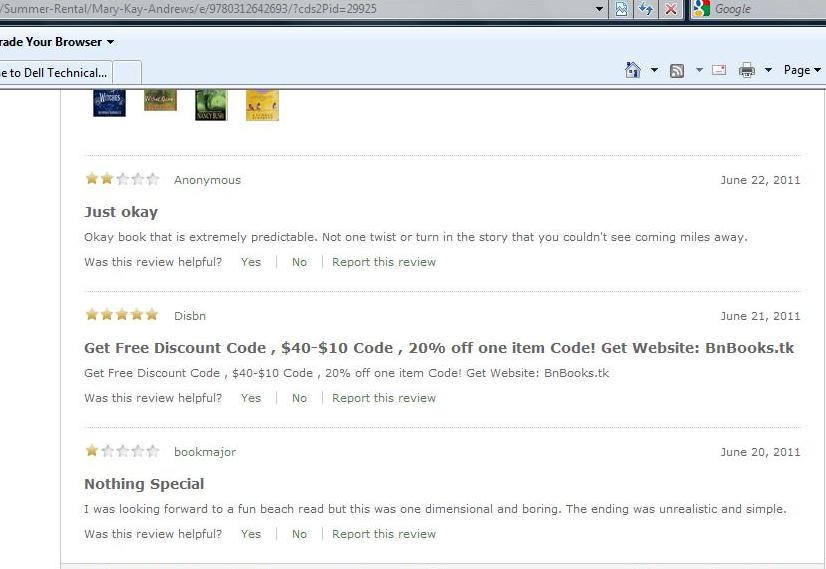
Oh, and my favorite, one review for a different book was a link to a competitor’s web site with the coupon code listed in the review.

Who cares? I certainly didn’t consider any of the four reviews to be relevant to the actual book. However, not every visitor to your product page will read the reviews, opting instead to just look at the average rating of all reviews. All irrelevant ratings affect the total average rating so delete the irrelevant reviews.

• Update your site policy to state that all irrelevant reviews will be deleted and include examples of irrelevant reviews. Make certain to include a link to this policy on the form page where your site visitors enter their reviews and prominently list your customer service phone number on both pages so any disgruntled customer can call and complain to a human being.

• In Barnes and Noble’s case, create a call-to-action button for visitors who have “comments” about your Nook and ebook pricing. Include that button on at least the product user review form page and site policy page. Then, link the call-to-action button to a page where you address the issue with ebook pricing (how are the prices determined, why are some prices higher than the paperback version of the book, why do prices differ between ebooks, etc.), the issue with employees overstating the benefits of buying the Nook, what you’re doing to resolve all issues and complaints, and then providing a form for your disgruntled customers to submit their comments and view the comments that other users submitted.

Option B: Dealing with Bad Reviews

• Do not delete the bad product reviews. The last thing you need is for the negative word-of-mouth to spread about how you’re deleting negative reviews and misleading the public.


• Have an employee monitor all product reviews, categorize the negative product reviews (furniture pieces not properly manufactured, sizing is too small or too big, colors of shoes don’t match, etc.) and forward the reviews to the appropriate staff members.

• Send a thank-you to each customer who had a bad experience, apologize for the problem(s), state how your company is resolving the issue and offer an incentive to return to your site and make another purchase.

In the overall scheme of the business world, you can plan ahead all you want but you will never be able to control how your customers or competitors behave. How is your company or client handling negative reviews and irrelevant reviews?

July 12, 2011

Pavlov’s Online Sweepstakes?

If Pavlov were alive today would he be working for the BIC Soleil razor brand? Based on BIC Soleil’s “100 Days of Sunny Moments” online sweepstakes, it’s highly possible.


The “100 Days of Sunny Moments” online sweepstakes contains four main points that not only make it a great example of how to run a sweepstakes, but also improves upon the Pavlovian concept seen in sites such as woot.com.

1. Daily Drawing with Four-Hour Entry Time Frame – Why condition dogs to drool when you can get humans to rush to your web site everyday from 1:00PM – 5:00PM ET to enter your daily drawing? Unlike most contests that offer a 24 hour entry period, BIC gives registered participants a four hour entry period.

2. Surprise Daily Bonus Prizes- I was pleasantly surprised one day to find that I could enter the bonus prize drawing for that day. BIC doesn’t list when their surprise bonuses will be held, which creates the extra incentive to return to the site each day, even if you’re not interested in the daily prize, so you don’t miss out on entering the drawing for the bonus prize.

3. Voting for Grand Prize as part of Entry – Instead of merely having participants enter the grand prize drawing, BIC has participants vote for one of two vacation spots while entering the grand prize drawing. The vacation destination with the most votes will be the grand prize. (This is also a fantastic way to end internal bickering in your department when it comes to choosing a grand prize.)

4. Transparency – BIC lists the daily prize winners and poll results for Grand Prize voting on the site so site visitors can see that the contest is legitimate.

If you’re going to have an online sweepstakes for a geographical region that only covers a few time zones, using the daily limited time period seems like a good way to increase repeat participation. What do you think?

June 14, 2011

Four Email Marketing Mistakes to Avoid

Some marketing emails I receive are so bad I wonder if the person who created and sent the email did so on purpose.  Are they getting revenge on a bad boss or client?  If you don’t want to fall into the “bad email marketing” category, here are four mistakes to avoid in your next email:
1.    Bland or Misleading Title – Your email title is often the only chance you get to capture your audience’s attention.  Why waste that opportunity with an email title that doesn’t compel the recipient to click through and read your email?  One restaurant I occasionally eat at has a track record for sending emails with titles that leave room for improvement:
a.    "We Belong to the Land" - advertising a one-man play (The title was in quotes on the email.)
b.    “A Matter of Taste” – promoting a wine tasting event
c.    “Gift Cards for Everyone!”  - trying to sell gift cards (Based on the title, I was expecting this to be a gift card giveaway.)
d.     “Thanks for Sticking With Us!” - thanking you for your business (Regardless of your type of business, certain phrases such as this title tend to imply that your customers have had negative experiences in the past.)
Get creative with your email titles but make certain that the titles you use imply exclusivity, offer a benefit for the reader (does not need to be a coupon or sale), and pertain to the purpose of the email.  For instance, Ace Hardware sent me an email with the title “Thank you for being one of our best customers!”  The restaurant could easily have used a similar email title that has a positive connotation and makes the reader feel appreciated instead of leaving the reader wondering if they want to risk a bad experience by visiting the restaurant.
2.    Irrelevant Graphics – Other than your logo and standard footer, and navigation bar for ecommerce sites, any graphics you include need to be relevant to the purpose of the email.  Having a wine tasting event?  Use an image of a glass of wine, a person drinking wine, or people at a wine tasting. Using the graphic below for a wine tasting doesn’t help to create any positive emotion that would compel a reader to spend money by registering for your wine tasting event.

3.    Bad Copy – Does your copy help create a scene or emotion that will cause the reader to click-thru and make a purchase, register for an event, or fill out a contact form?  If not, why are you wasting this opportunity?  Even battery-powered, scented candles can be sold by using email copy such as “It’s cold and dark outside, but you’re relaxed and rejuvenated indoors with your everlasting wax candles.  No open flame or melting wax to worry about.  And, each candle lasts more than 100,000 hours.  Available in three stress-reducing scents.”
Also, communicate to your readers in their language and terminology.  The restaurant mentioned in #1 used this copy in their email trying to get readers to buy gift cards:

Firstly, who says, “Let’s close the deal.”?  Secondly, giving someone a restaurant gift card as a present will probably not result in the gift receiver “marveling at your generosity”, especially if the gift receiver spent half a day shopping for the perfect present for you.  Email copy that conveyed how buying this restaurant’s gift cards at the last minute could save the gift giver from the embarrassment of not having any gifts to give would have been an improvement over the existing copy.
4.    No Call-to-Action – Using “click here” should be outlawed in emails.  (If you’re not certain about this, it’s time to A/B test the call-to-action used in your emails.) What action do you really want the reader to take? Use a call-to-action that spells out what action you want the reader to take such as “Register Now” or “Find Your Favorites”. 
The bottom line is that if you’re not sending out quality emails to everyone on your mailing list, you’re only hurting your business or organization.
Now, it’s your turn.  Take a look at emails you’ve sent in the past.  Are there any parts of the emails that could have been improved?  Or, have you ever dealt with a client who refused to allow you to improve their emails?

DQJAPDPYAQU5

June 5, 2011

Why the Fat Lady Sang

It isn’t over till the fat lady sings.” In my family, this quote is used during sporting events with anyone attempting to gloat before the event is finished. After all, the opera isn’t finished until the fat lady sings.  In the case of Halls latest online marketing campaign, it appears that the fat lady sang before the campaign ended.
I learned of Halls’ The Operahh of Irritations campaign via email.  The campaign requested that people state, via Twitter or facebook, what irritates them and Halls would have opera singers sing those comments, which could be watched live on facebook.  I tweeted my comments for the opera singers, including the hashtag Halls created, and clicked through to the campaign facebook page only to see two bored opera singers with nothing to sing and that I was one of 61 viewers. 

Later that day, the Halls Twitter account @GetHalls followed me.  (The Halls Twitter account had about 45 friends – accounts they were following - and 23 followers that day, May 20.)
While I missed the operatic version of my tweet, I couldn’t help but think about what companies could do to improve the results of their marketing campaigns:
·    Identify Your Customers – Who are they?  What are their likes and dislikes?  How does your campaign idea fit with your customers?  If the campaign isn’t a good fit, are you really going to attract enough new customers to make up the revenue for the customers you’ll lose with this marketing campaign?  What percentage of Halls customers are opera fans?  (On the positive side for Halls, their reach was so low with this campaign that there aren’t that many people who will look at a bag of Halls and think of the opera.)

·    Use Twitter to Build Relationships – It appeared that Halls didn’t even have a Twitter account before they decided on their opera campaign, and Halls did a poor job of creating their Twitter account.  Make certain when you create your company account that you use the company logo, include your URL and a description of your company, and make certain any background image you use ties in with your brand.  Don’t assume that anyone knows about your company or what products you make or sell. 
How can you tell what this company does?

Next, search for people tweeting about your industry and build relationships with them.  (Search for complaints, too, and don’t just search based on hashtags.) It’s okay to tweet those people and say that you agree with them, or just tweet them a link to some resources that are not on your web site.  (During a short stint with a small ecommerce site, I tweeted a man who was looking for a specific item that the site didn’t carry.  My tweet included two links to competitors’ sites.  If you don’t have the product that someone tweets they’re looking for, point them in the right direction.  They’ll remember you tried to make their life easier.)  Then work on increasing your interaction with your customers and potential customers.  Ask for their input and feedback, share exclusive news with them, etc.  Make interacting with you so enjoyable that people tweet about you.
·    Tell the Truth – People can find out the truth in a hurry.  If your campaign wasn’t a success, don’t claim that it was.  Just tweet your thanks to everyone who participated.

·    Test in Advance – If any part of your campaign involves using equipment for video or transmitting a live feed, test everything in advance. Twice.  The last thing you want is to have technical problems the moment your campaign is supposed to be live.  You might not think that technical problems affect your brand/company image but the people deciding which vendor to hire or which product to purchase will disagree with you.
If Halls had planned ahead, this campaign probably would have had better results, even though I doubt many Halls customers are big opera fans.  What do you think?